
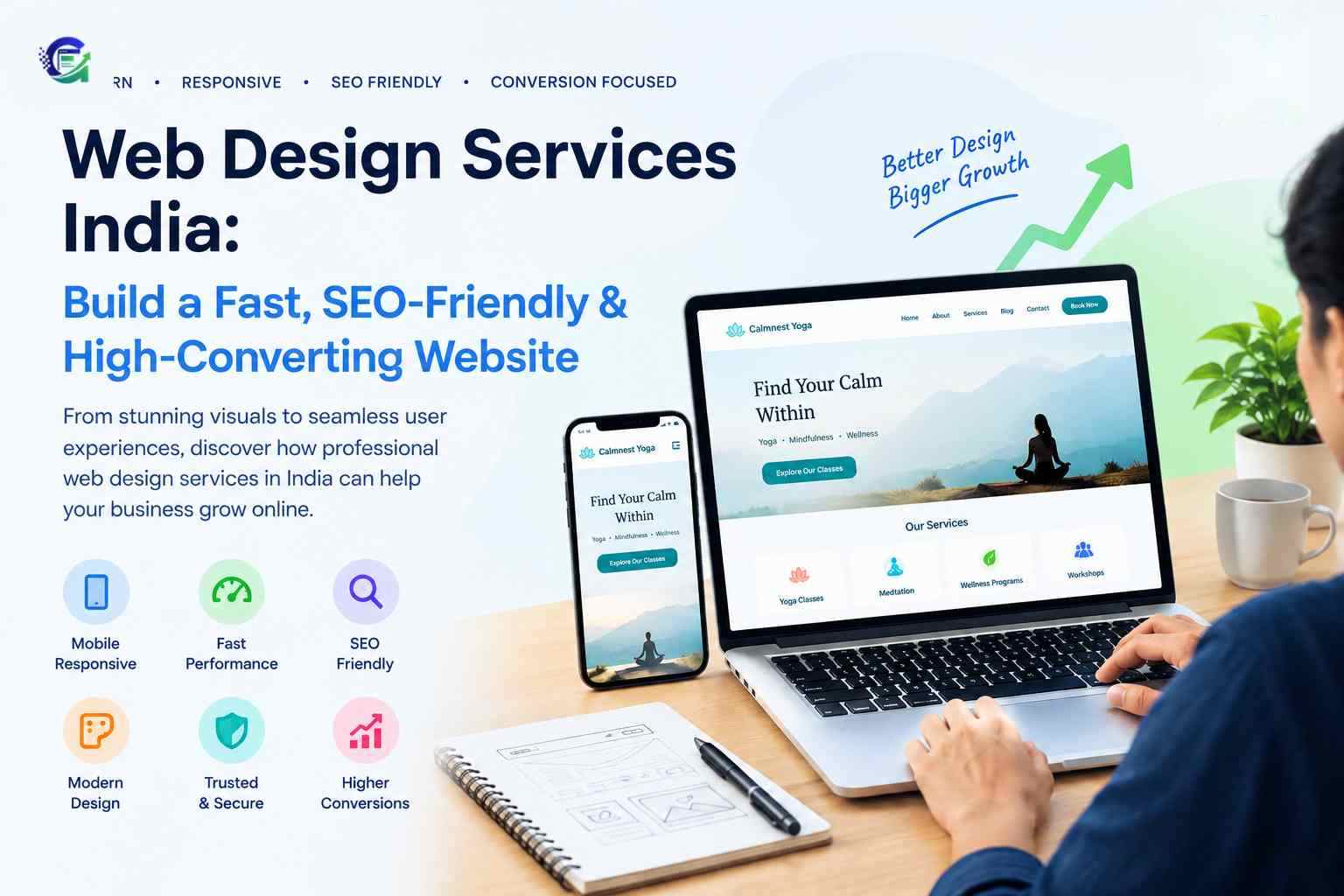
Introduction: A Website Should Do More Than Look Good
Client: "I need a new website. I want it to look modern and impressive."
Designer: "That's a good start. But let me ask you something more important—what do you want the website to do for your business?"
That question often changes the conversation. A beautiful website that doesn't generate enquiries, explain your services clearly, or appear in search results is essentially a digital brochure sitting in a drawer. It looks nice, but it doesn't work.
This is where professional Web Design Services India becomes genuinely valuable. Modern website design isn't just about selecting a colour palette or arranging sections on a homepage. It requires balancing visual design, user experience, mobile responsiveness, page performance, SEO, accessibility, and conversion strategy. A website that ignores any one of these areas leaves opportunities on the table.
Whether you run a local service business in Pune, a growing e-commerce brand in Bengaluru, or a startup preparing to scale, the quality of your website directly shapes how potential customers perceive and interact with your business. This article is written for business owners and decision-makers who want to understand what professional website design actually involves—before they hire anyone.
What Are Web Design Services in India?
Professional web design services go far beyond making a website "look good." They cover the planning, design, and structural decisions that determine how well a website performs for both users and search engines.
Here's what a comprehensive web design engagement typically includes:
Website structure and architecture: Deciding how pages are organised, how navigation flows, and how visitors move from landing to enquiry.
UI design: The visual elements—layout, colour, typography, buttons, spacing—that create a consistent, professional appearance.
UX design: How easy and intuitive the website feels to use. Good UX means visitors find what they need without confusion or frustration.
Responsive design: Ensuring the website works correctly on mobile phones, tablets, laptops, and desktops. With mobile-first indexing from Google, this is non-negotiable.
Navigation design: Clear menus, breadcrumbs, and internal links that help users and search engines understand your site's content.
Visual hierarchy: Guiding the visitor's eye toward what matters most—your value proposition, services, and calls to action.
CTA placement: Strategically positioning enquiry buttons, contact forms, and phone numbers where visitors are most likely to act.
Landing pages and service pages: Purpose-built pages that address specific customer needs and search queries.
Contact forms and lead systems: Functional forms that capture enquiries without friction.
Brand consistency: Aligning the website with your brand identity across all pages.
Performance considerations: Designing with page speed in mind from the start, not as an afterthought.
SEO-friendly structure: Clean URLs, proper heading hierarchy, schema markup, and crawlable links that help Google understand your content.
When you hire a website design company India-based, you are paying for all of these decisions—not just the final visual output.
What Makes a Modern Business Website Effective?
A website can be attractive and still fail. Effectiveness comes from several interconnected elements working together.
Mobile-First Design
More than half of all web traffic in India comes from mobile devices. If your website requires pinching, zooming, or horizontal scrolling on a phone, visitors will leave. Mobile-first design means designing the mobile experience first—then scaling up for larger screens. Google uses mobile-first indexing, which means it primarily evaluates your mobile version when determining search rankings.
Fast Performance
Page speed affects both user experience and search visibility. Google's Core Web Vitals measure loading performance (Largest Contentful Paint), interactivity (Interaction to Next Paint), and visual stability (Cumulative Layout Shift). A slow website frustrates users and signals poor quality to search engines.
Clear Navigation
Visitors should never have to guess where to find information. A well-organised menu, logical page hierarchy, and internal links make it easy for users to explore your services and for search engines to crawl your content.
Strong Visual Hierarchy
Not every element on a page deserves equal attention. Visual hierarchy uses size, colour, spacing, and position to guide visitors toward the most important information—your value proposition, key services, and calls to action.
Conversion-Focused CTAs
Every page should have a clear next step. Whether it's "Request a Quote," "Book a Consultation," or "Call Now," CTAs should be visible, compelling, and placed at natural decision points.
SEO-Friendly Structure
Search engines need to understand your content. Clean URLs, descriptive headings, schema markup, and properly structured data all contribute to better visibility in search results. You can explore this topic in more depth through SEO-friendly website development.
Trust-Building Content
Visitors decide within seconds whether they trust your business. Clear service descriptions, transparent pricing guidance, real project examples, and professional presentation all contribute to credibility.
Scalable Design
A website built for today should accommodate tomorrow's growth. Whether you plan to add an e-commerce store, a blog, or new service pages, the underlying design and development should support expansion without requiring a complete rebuild.
Custom Website Design vs Template-Based Design
This is one of the most common decision points for businesses in India. Both approaches have legitimate use cases.
Template-based websites use pre-designed themes that are customised with your content, colours, and logo. They are faster and cheaper to launch, but they come with constraints. Custom website design, as the name suggests, is built specifically for your business—your structure, your user journey, your brand.
Factor | Template-Based Website | Custom Website Design |
|---|---|---|
Design flexibility | Limited to theme options | Fully tailored to your brand |
Branding | Generic look shared by many sites | Unique visual identity |
Depends on theme quality and plugins | Optimised from the ground up | |
SEO flexibility | Constrained by theme structure | Full control over architecture |
Limited by platform constraints | Designed for growth | |
Custom functionality | Often requires workarounds | Built to specification |
Long-term flexibility | Can become restrictive | Adaptable as needs evolve |
Best suited for | Simple sites, tight budgets, quick launches | Businesses with specific goals and growth plans |
Template-based websites can work well for personal portfolios or very small businesses that need a basic online presence quickly. Custom web design India projects are better suited for businesses that view their website as a growth asset—where user experience, search visibility, and conversion matter.
Neither approach is universally right. The question is whether a template can genuinely support your business objectives, or whether its limitations will cost you more in the long run.
How Much Do Web Design Services Cost in India?
There is no single answer to this question, and any company that promises one is probably oversimplifying. Pricing depends on scope, complexity, and what the project actually requires.
General market ranges for websites in India vary widely. Basic websites with a few pages typically start from around ₹10,000–₹25,000, while professional business websites with CMS, custom design, and advanced features can range from ₹25,000 to ₹60,000 or more. For more comprehensive builds with custom functionality, e-commerce, or web application features, costs can run significantly higher.
What drives the price? Several factors:
Number of pages and unique designs
Custom UI/UX work
CMS requirements (WordPress, headless CMS, or custom)
E-commerce functionality
Third-party integrations (payment gateways, CRMs, booking systems)
Content creation and copywriting
SEO requirements
Animations and interactive elements
Custom development work
Performance optimisation
Post-launch maintenance and support
The important distinction is not how much you pay, but what you are paying for. A very cheap website often excludes content creation, SEO work, testing, and post-launch support. A professionally designed business website includes these elements because they are essential to the website achieving its purpose.
If you want a more detailed breakdown of pricing factors, website development cost in India covers this in depth.
Before requesting a quote, prepare a clear list of your goals, required pages, specific features, and target audience. The more specific your brief, the more accurate—and useful—the proposal will be.
What Should You Ask Before Hiring a Web Design Company in India?
A good proposal answers these questions before you ask. A weak one leaves them vague. When evaluating a web design company India-based, use this checklist:
Will the design be custom or template-based?
Is the website mobile responsive by default?
Is SEO considered during design and development?
Who owns the website, source code, and hosting access after launch?
What technology or CMS will be used?
Is performance optimisation included?
Are lead-generation systems (forms, CRM integration) included?
Will the website be easy for me to update?
Is post-launch support available, and for how long?
What happens if I need additional pages later?
How are revisions handled, and how many are included?
What exactly is included in the quoted price—and what is not?
If a proposal avoids these questions, that itself is a signal. Transparency about scope, ownership, and support is a sign of a professional website design agency India-based that values long-term relationships over one-time transactions.
How Website Design Affects SEO and Google Visibility
Design and SEO are not separate disciplines. The structural decisions made during design directly impact how well your website performs in search.
Search engines need to understand your content, and the way your site is built determines how easily they can do that. Key areas where design affects SEO include:
Site structure and heading hierarchy: Logical use of H1, H2, and H3 tags helps search engines understand content hierarchy.
Internal linking: Links between related pages help Google discover and rank your content.
Mobile usability: Google primarily uses the mobile version of your site for indexing and ranking.
Page speed: Core Web Vitals like LCP, CLS, and INP directly influence page experience signals.
Image optimisation: Compressed, properly sized images with descriptive alt text improve both performance and accessibility.
Crawlability: Search engines must be able to access and render your content.
Metadata and schema: Title tags, meta descriptions, and structured data help your pages appear correctly in search results.
You can read more about optimising these elements in our guide on improving website performance and Core Web Vitals. Tools like Google's PageSpeed Insights provide detailed reports on performance, accessibility, and SEO for any page.
Website Design Case Study — Calmnest Yoga
A good example of how thoughtful website design can support a brand's identity is Calmnest Yoga (https://calmnestyoga.com/), a project in SiteGrowza's portfolio under the health and wellness category.
From a design perspective, the Calmnest Yoga website demonstrates several principles that are relevant to wellness brands. The visual presentation is calm, clean, and aligned with the nature of a yoga practice—avoiding aggressive colours or cluttered layouts. The user experience is straightforward, with clear pathways to explore services and learn about the offering.
For wellness businesses in India, trust and clarity matter enormously. Visitors are often evaluating whether a studio or practitioner feels right for them. A professionally designed website supports that evaluation by presenting information clearly, maintaining visual consistency, and creating a digital presence that feels as considered as the in-person experience.
The Calmnest Yoga project illustrates how design choices—layout, typography, pacing, imagery—can reinforce a brand's positioning. It's not about flashy animations or overwhelming visuals. It's about creating a digital space that feels appropriate for the business and easy for visitors to navigate.
SiteGrowza's Approach to Web Design Services India
SiteGrowza works with businesses across India on custom website design and development. The approach is built around a simple principle: a website should not only look premium; it should help the business attract, inform, engage, and convert the right visitors.
The work typically involves:
Custom website design that reflects the client's brand
Modern UI/UX principles focused on clarity and usability
Responsive development for all devices
SEO-ready structure from the foundation
Performance optimisation as a design priority, not an afterthought
Conversion-focused layouts and CTAs
Modern technology and scalable architecture
Post-launch support and guidance
For businesses that need functionality beyond a standard website, custom web development capabilities are available. And if you want a broader overview of what professional design services involve, website design services India covers the full scope.
SiteGrowza does not claim to be "India's #1" or the "best web design company." The focus is on doing good work, communicating transparently, and building websites that serve real business purposes.
What Makes SiteGrowza Different?
The table below presents a general comparison of common approaches in the market. It is intended as a framework for thinking about different service models, not as a verified claim about any specific competitor.
Feature | Basic Website Provider | Typical Template Approach | SiteGrowza Approach |
|---|---|---|---|
Custom UI | Limited | Limited | Custom-focused |
Mobile responsiveness | Basic | Usually included | Mobile-first |
SEO foundation | Varies | Depends on setup | SEO-ready structure |
Performance | Varies | Depends on theme and plugins | Performance-focused |
Conversion strategy | Often limited | Template dependent | Conversion-focused |
Scalability | Limited | Depends on platform | Built for growth |
Support | Varies | Varies | Post-launch support |
Custom functionality | Limited | Limited | Custom solutions available |
The difference lies in the depth of consideration given to each layer of the website—from the initial structure through to how the site will be maintained and evolved over time.
A Practical Web Design Process for Indian Businesses
A reliable web design process follows a logical sequence. Skipping steps creates problems later.
Discovery: Understanding your business, audience, competitors, and goals.
Sitemap and structure: Planning the pages and navigation architecture.
Content planning: Deciding what content goes where, and what it needs to communicate.
UI/UX planning: Wireframing layouts and user flows before visual design begins.
Visual design: Creating the look and feel of key pages.
Development: Building the website with clean, performant code.
Mobile optimisation: Ensuring the mobile experience is excellent.
SEO implementation: Adding metadata, schema, internal links, and technical SEO foundations.
Performance testing: Checking page speed and Core Web Vitals.
Quality assurance: Testing forms, links, cross-browser compatibility, and edge cases.
Launch: Deploying the website and monitoring for issues.
Post-launch improvements: Refining based on real user behaviour and feedback.
Each step matters. Skipping discovery leads to a website that doesn't serve its audience. Skipping QA leads to broken forms and lost leads. Skipping SEO implementation means the website won't be found.
How to Choose the Right Web Design Services India for Your Business
Different businesses have different priorities. A decision framework helps clarify what matters most for your situation:
Local service businesses (plumbers, clinics, salons): Trust, lead generation, local visibility, easy contact.
Startups: Strong branding, scalable architecture, room to add features as the business grows.
E-commerce businesses: Product experience, checkout flow, performance under traffic.
Consultants and coaches: Authority positioning, clear service explanations, lead capture.
Wellness businesses: Calm visual identity, trust-building, intuitive navigation.
Agencies and studios: Portfolio presentation, credibility, clear service offerings.
Growing companies: Scalable design, integrations, and the ability to expand without rebuilding.
A professional web design partner should understand these differences and tailor their approach accordingly. A one-size-fits-all template won't serve every business equally well.
Final Takeaway
Good web design combines design, UX, SEO, performance, content, conversion strategy, and scalability. When these elements work together, a website becomes a genuine business asset—not just a digital business card.
Before choosing a web design partner, ask what you are actually getting—not just how the homepage will look. Ask about structure, SEO, performance, ownership, and support. A professional web design consultation can help you identify what your website truly needs.
If you are exploring Web Design Services India options, you can explore SiteGrowza's work or start a conversation about your requirements. The goal is not just to launch a website, but to launch one that earns its place in your business.